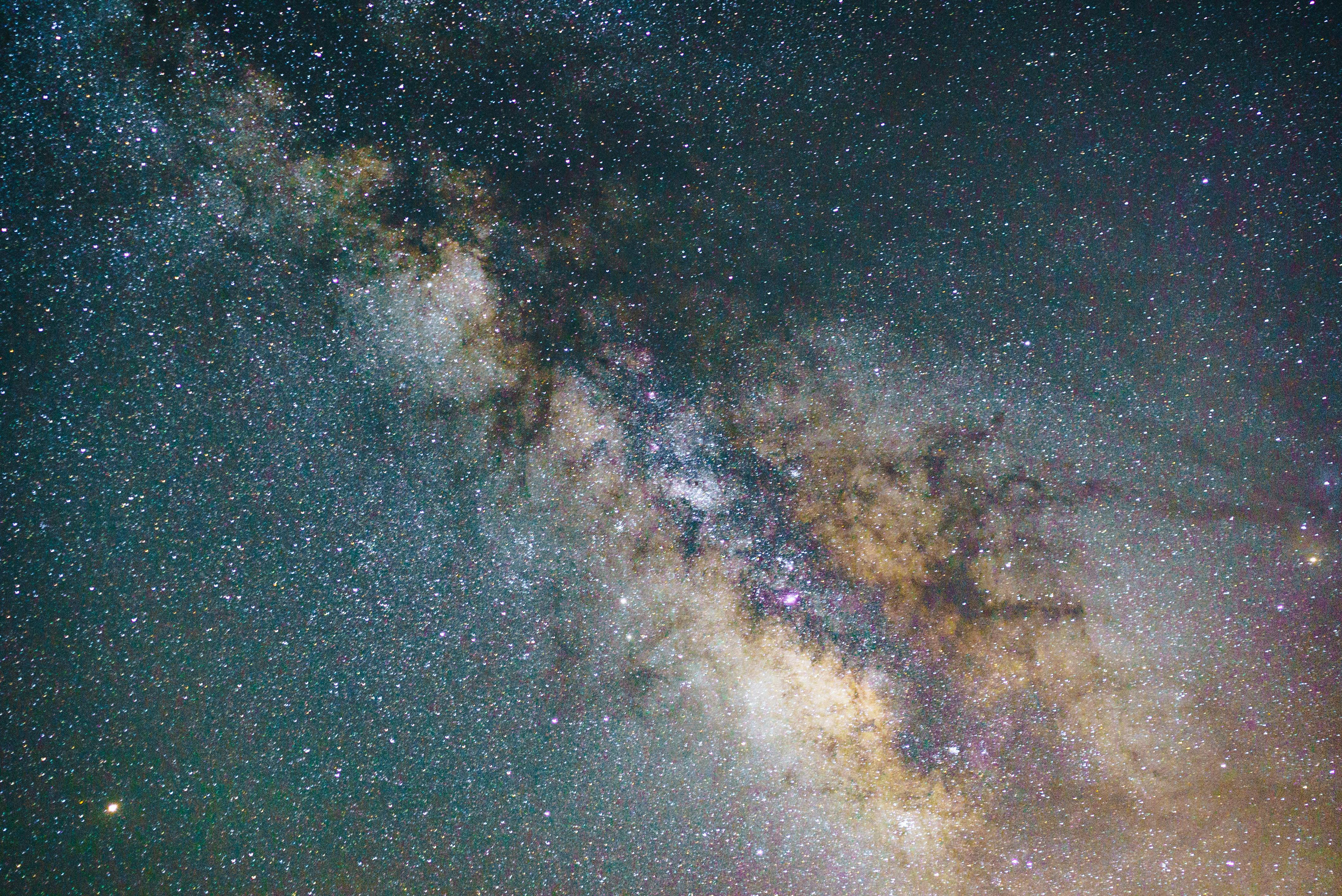
AI Simulation of the Milky Way Galaxy: Tracking 100 Billion Stars with Unprecedented Precision

A Scientific Breakthrough: AI Simulation of the Milky Way Galaxy
A team of researchers from the RIKEN iTHEMS Center in Japan, in collaboration with the University of Tokyo and the University of Barcelona, has achieved a historic milestone by creating the first AI simulation of the Milky Way Galaxy that accurately tracks the evolution of over 100 billion individual stars over a period of 10,000 years. This marks a revolutionary step forward in computational astrophysics, moving from approximations of stellar masses to star-by-star modeling with extraordinary detail.
How the AI Simulation of the Milky Way Galaxy Works
For the first time, scientists integrated deep learning technology with high-resolution numerical physics models to accelerate calculations by 100 times, while enhancing spatial and temporal resolution. The AI simulation of the Milky Way Galaxy captures nuanced stellar behavior, gas movement, and energetic events—such as supernova explosions—at a level previous models could not achieve due to computational limitations.
The researchers trained an AI surrogate model using ultra-detailed simulations of supernova expansion, allowing the system to reproduce 100,000 years of stellar impact in milliseconds during the full galactic simulation.
Challenges Overcome by the AI Simulation of the Milky Way Galaxy
Simulating the Milky Way in full resolution was long considered nearly impossible. Traditional models could only simulate the equivalent of 1 billion solar masses, forcing scientists to group stars into massive clusters, which led to oversimplification and loss of critical data. Rapid changes, such as shockwaves from supernovae, were ignored or approximated due to hardware constraints.
Computing Speed: From Decades to Days
Thanks to the AI integration, simulations that previously would have taken over 36 years to compute can now be completed in approximately 115 days. Using Japan’s supercomputers Fugaku and Miyabi, the team managed to simulate one million years in just 2 hours and 78 minutes, processing up to 300 billion particles across more than 7 million CPU cores.
This dramatic speed increase enables scientists to run multiple scenarios and explore alternate evolutionary paths of the galaxy.
Scientific Insights from the AI Simulation of the Milky Way Galaxy
The simulation shows how supernova-driven gas structures create spiral arms, star formation zones, and hot plasma bubbles that circulate and replenish the galactic disk. It enables high-precision tracking of heavy element formation—key to assessing the conditions for life beyond Earth.
By combining simulation outputs with real data from telescopes like Gaia and James Webb, astronomers can now more accurately model the structure, thickness, and long-term evolution of the Galaxy.
Wider Applications Beyond Astronomy
Experts emphasize that the approach behind the AI simulation of the Milky Way Galaxy could transform modeling in climatology, ocean sciences, and geophysics. Any system that relies on capturing interactions between microscopic and large-scale dynamics could benefit from this method.
Researchers believe that merging artificial intelligence with computational physics will transform simulations into engines of scientific discovery, rather than just replicators of known phenomena.
Why This Landmark Simulation Matters
✔ First galaxy-scale simulation to model every single star individually
✔ 100× higher resolution and speed than legacy models
✔ Enables multi-scenario testing and long-term predictions
✔ Marks AI as a core partner to supercomputers and telescopes
✔ Sets the stage for simulating other galaxies—or even the observable universe
The AI simulation of the Milky Way Galaxy is not just a technical triumph; it signals the dawn of a new era where AI augments scientific exploration, enabling humanity to better understand the origin and future of cosmic systems.
Read more: