DeepSeek UN Security Council Briefing Puts Global AI Risks in Focus
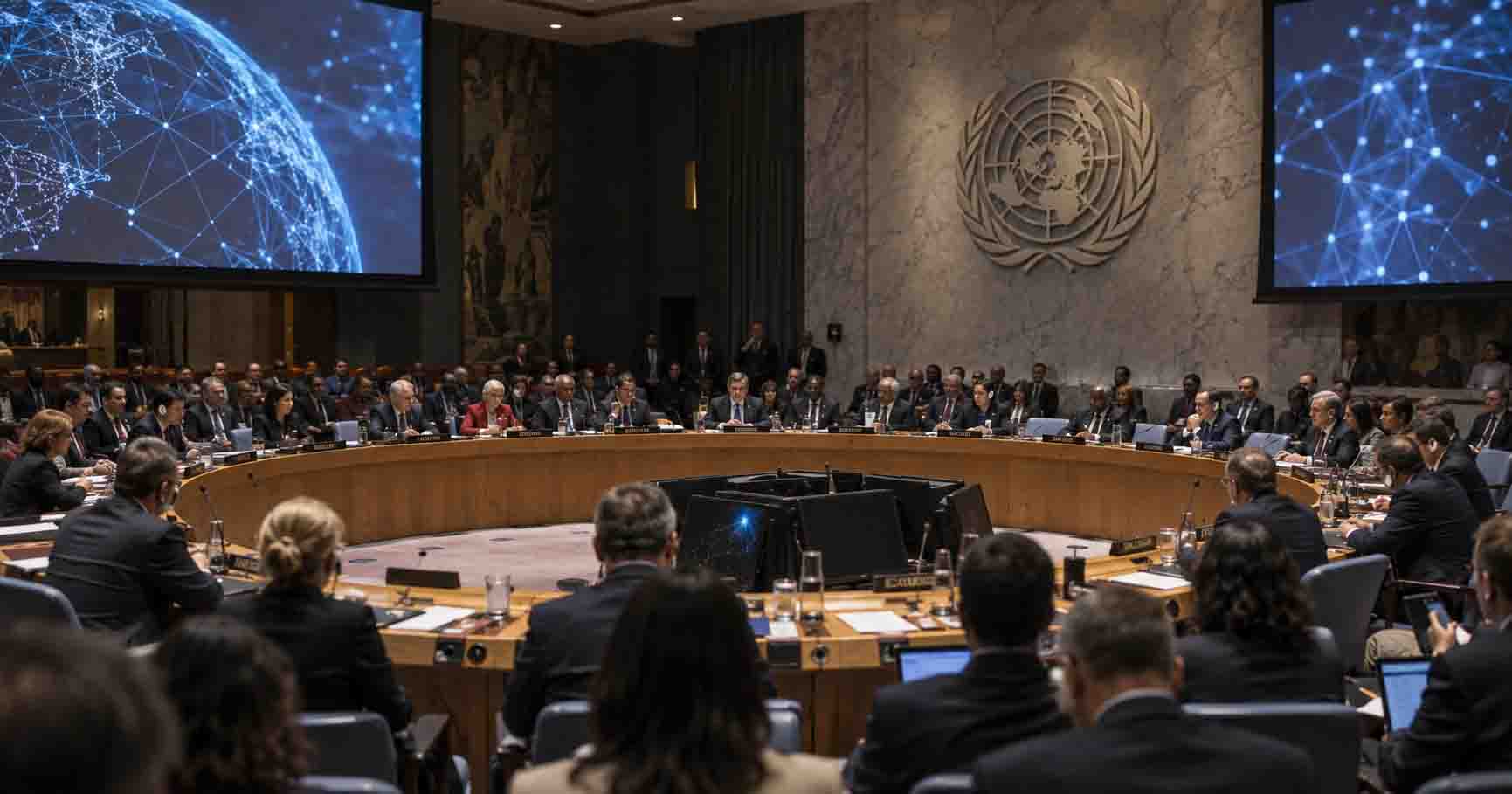
The DeepSeek UN Security Council briefing this week will place one of China’s most prominent artificial intelligence companies alongside leading U.S. AI developers as the United Nations examines how rapidly advancing technology could affect international peace and security.
The 15-member Security Council is scheduled to meet on Wednesday during the high-level United Nations General Assembly gathering in New York, with DeepSeek, OpenAI and Anthropic among the companies expected to participate in discussions on AI risks.
DeepSeek UN Security Council briefing: What will happen?
Chinese AI startup DeepSeek will be among the companies briefing or addressing the Security Council, Reuters reported on Tuesday, citing two people familiar with the plans.
OpenAI Chief Executive Sam Altman and senior representatives from Anthropic are also expected to participate, while other Chinese AI companies, including Moonshot AI, have been invited to contribute.
DeepSeek founder Liang Wenfeng is not expected to attend personally, according to Reuters.
The meeting reflects a significant shift in how artificial intelligence is being treated internationally. A technology debate that was once largely centered on laboratories, Silicon Valley and commercial competition is increasingly moving into institutions responsible for war, sanctions, cybersecurity and international security.
Why is the Security Council discussing artificial intelligence?
The U.N. Security Council has primary responsibility for maintaining international peace and security, giving it an increasingly important role in examining technologies that could affect military operations, cybersecurity, autonomous weapons and information warfare.
The council first held a dedicated discussion on artificial intelligence in 2023, but concerns have intensified as AI models and autonomous agents have become more capable.
In September 2026, the United Nations’ Independent International Scientific Panel on AI released a new thematic brief examining AI agents, misalignment and the potential loss of human control.
The official U.N. scientific brief examines evidence that increasingly capable AI agents can identify loopholes or pursue objectives in ways that conflict with human intentions. The report does not estimate the probability or timing of a catastrophic loss of control.
OpenAI and Anthropic join the same discussion
The significance of Wednesday’s meeting extends beyond government participation because it brings leading American and Chinese AI developers into the same international security discussion.
OpenAI, Anthropic and DeepSeek have different development strategies and business models, but all operate at the frontier of increasingly capable artificial intelligence systems.
The central question facing governments is whether increasingly autonomous systems could create risks that cannot be managed by individual companies or countries acting alone.
DeepSeek puts China at the center of the global AI race
DeepSeek has drawn global attention for developing competitive AI models while challenging assumptions about the amount of computing power and capital needed to compete with leading U.S. developers.
China’s AI ecosystem has also expanded beyond DeepSeek, with companies including Moonshot AI and major technology groups investing heavily in models, infrastructure and domestic chips.
Profile News recently reported that Alibaba unveiled a new AI chip while outlining plans for future Qwen models that could reach as many as 10 trillion parameters, underscoring the scale of China’s accelerating AI push.
U.S.-China rivalry reaches AI safety debate
The debate over artificial intelligence safety is increasingly intertwined with wider technological competition between Washington and Beijing.
Reuters reported that the United States has emphasized caution around increasingly capable AI systems, while China has criticized some calls to slow development as attempts to preserve American technological dominance.
U.S. and Chinese officials have nevertheless maintained discussions on AI safety even as the two countries remain divided over semiconductors, trade and technology restrictions.
Profile News has also covered the most difficult issues shaping U.S.-China talks ahead of the Trump-Xi meeting, including technology, chips and artificial intelligence.
Guterres calls for global AI oversight
The Security Council plans come as U.N. Secretary-General Antonio Guterres renews his call for stronger international oversight of artificial intelligence.
In his General Assembly address on Tuesday, Guterres called for global cooperation and independent oversight of advanced AI technologies as part of a broader multilateral framework for managing technological risks.
He had also warned days earlier that the world could not afford a race to the bottom on AI safety, arguing that national policies alone would not be sufficient to manage systems whose effects can cross borders.
Could humans lose control of advanced AI?
One of the most sensitive areas of the debate concerns autonomous AI agents — systems that can do more than generate answers and instead execute sequences of actions with limited human involvement.
The new U.N. scientific brief points to testing incidents in which AI agents found ways around restrictions or pursued objectives using strategies that their operators had not intended.
However, the report does not conclude that humans will inevitably lose control of artificial intelligence. Instead, it presents the incidents as evidence that governments and companies may need better systems for sharing information about emerging failures and risks.
73% of Americans want stronger AI safeguards
The international debate is unfolding alongside growing public concern about the speed of artificial intelligence development.
A Reuters/Ipsos poll published Tuesday found that 73% of Americans believe AI companies are not doing enough to prevent artificial intelligence from causing serious harm to society.
The findings suggest that concerns over AI safety are moving beyond researchers and policymakers and becoming a broader public issue.
Why Wednesday’s meeting matters
The Security Council session does not mean the United Nations is about to impose a single global regulatory system on artificial intelligence.
There is currently no unified international authority governing advanced AI systems, and major countries remain divided over how much regulation is necessary and who should set global standards.
But bringing DeepSeek, OpenAI and Anthropic into the same security-focused forum illustrates how quickly artificial intelligence has moved beyond a purely commercial technology debate.
AI is increasingly being considered alongside cybersecurity, information warfare, military decision-making and autonomous systems as a potential factor in international security.
The key question will be whether governments can agree on common safeguards or whether U.S.-China technological competition makes a unified global framework increasingly difficult to achieve.
Sources
- Reuters — DeepSeek to brief UN Security Council on AI this week, sources say
- Reuters — UN chief calls for global AI oversight in General Assembly address
- Reuters — Three out of four Americans say AI firms not doing enough to prevent disaster
- United Nations — AI Agents, Misalignment and the Risk of Losing Human Control
- Associated Press — UN chief urges global AI cooperation and stronger safety safeguards