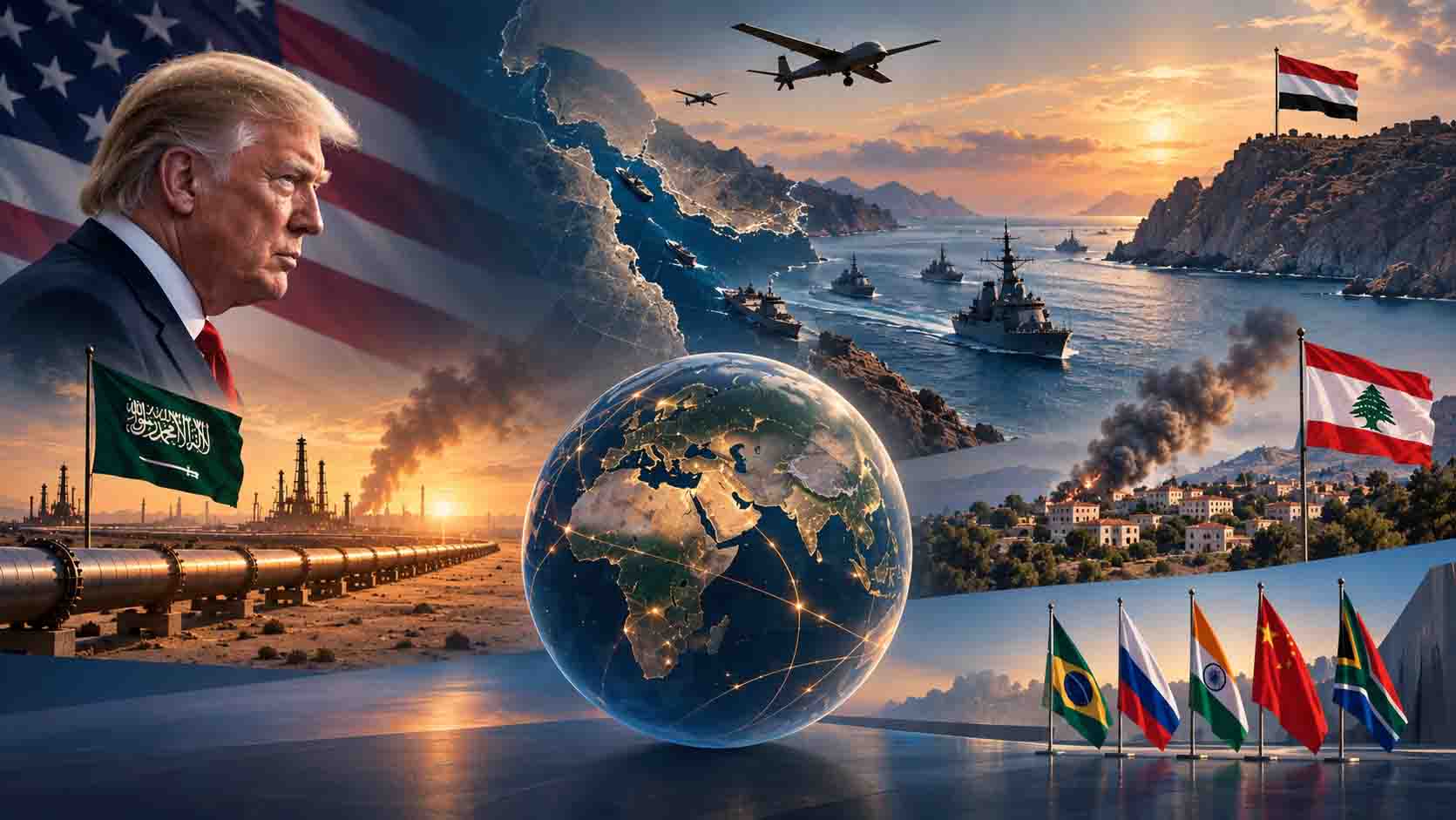
National Economies in an Age of Global Imbalance | Dr. Nabila Afif Ghosn
This article is published under the “Writers’ Platform” section and reflects the author’s views based on her political analysis of current events. The opinions expressed herein do not necessarily reflect the editorial position of Profile News.


Writers’ Platform
Dr. Nabila Afif Ghosn
Writer and researcher focusing on geopolitics and regional transformations in the Middle East
National Economies in an Age of Global Imbalance: A Social Nationalist Reading of the Asheville Summit and the Struggle of Global Blocs
The meeting of G20 finance ministers in Asheville was more than a technical debate over trade surpluses and “macroeconomic imbalances.” The disputes over industrial policy, government subsidies, and global supply chains exposed a deeper struggle over markets, production, and economic influence at a time when the international balance of power is rapidly shifting.
Behind the language of financial policy lies a broader conflict over who will shape the rules of the global economy. Established Western powers are seeking to defend an economic order built during decades of their dominance, while rising competitors challenge their influence and the rules that once appeared settled.
The tensions that emerged in Asheville therefore reflect more than disagreements over economic policy. They point to a period of structural change in which trade, production, finance, and technology have become central instruments in an increasingly competitive struggle among major powers.
Western Economic Policy and the Politics of Double Standards
The United States and its Western allies continue to defend an international economic framework shaped largely during periods of their historical dominance. Yet one of the defining contradictions of this framework is the gap between its stated principles and its actual practice.
The powers that advocate “free markets” and “fair competition” often resort to tariffs, restrictions, and industrial protection when foreign competition threatens their domestic industries. Similarly, economic sanctions and financial restrictions have become instruments of political pressure against states that challenge established geopolitical interests.
The issue, therefore, is not simply whether markets should be free or regulated. The more fundamental question is who has the power to define the rules—and under what circumstances those rules are applied.
Free trade is often promoted when it serves the interests of dominant economies, while protectionist measures reappear under terms such as “economic security,” “strategic industries,” and “national security” when those interests are threatened.
The global economy has never been a completely neutral arena in which all nations compete under identical conditions. Political influence, technological capacity, financial power, and control over international institutions continue to shape the terms of competition.
Production Before Dependency
For any nation seeking long-term economic strength, productive capacity remains essential. An economy that relies heavily on imports, foreign currencies, and external supply networks remains vulnerable to decisions made beyond its borders.
Economic strength is built not only through trade and investment, but through the ability to develop industry, agriculture, infrastructure, science, and technology. The factory, the field, the laboratory, and the transport network are therefore as important to national development as financial indicators and trade agreements.
This does not mean isolation from international markets. Nor does it require rejecting trade or cooperation. The challenge is to establish balanced economic relationships that strengthen domestic capabilities rather than permanently replace them.
Blind integration into global supply chains can create dependency when the most valuable stages of production, technology, and finance remain controlled elsewhere. By contrast, a productive national economy can participate in international trade while retaining the capacity to respond to external shocks and protect its essential industries.
China, Trade Surpluses, and the Struggle for Markets
The disagreements surrounding China’s economic policies in Asheville reflect the broader competition now reshaping the international system. China seeks to preserve an economic model supported by vast productive capacity and exports, while the United States and several Western economies increasingly view these exports and industrial policies as a direct challenge to their own manufacturing sectors.
Yet the debate extends beyond China itself.
At its core lies a broader struggle over who will shape the next phase of the global economy. Every major power supports international rules that correspond, to varying degrees, with its strategic and economic interests. As the balance of power changes, the struggle to redefine those rules becomes increasingly intense.
For smaller and developing nations, the emergence of a multipolar world may create new opportunities. However, it does not automatically guarantee greater independence or economic development. A shift from one dominant economic partner to another can simply reproduce old patterns of dependency under different political and geographical conditions.
The objective should therefore not be blind alignment with either the West or the East. A more sustainable approach requires building sufficient domestic capacity to engage with different powers according to national interests rather than economic necessity.
National Markets Are Not Outlets for External Crises
In a global economy marked by overproduction in some regions and insufficient demand in others, national markets can become targets for absorbing surplus production.
When demand weakens within a major economy, governments and corporations naturally search for external markets. Without adequate policies, this can place significant pressure on local industries and employment in countries with less developed productive sectors.
For this reason, protecting domestic industry should not be dismissed automatically as economic isolation. Governments have a legitimate interest in preventing unfair competition, supporting strategic sectors, and ensuring that trade contributes to domestic development.
The challenge is to distinguish between reasonable economic protection and policies that create permanent inefficiency. Effective national economic policy must encourage production and innovation while ensuring that local industries are capable of developing and competing over time.
Countries should not become passive consumers of goods produced elsewhere, nor should their economic policies be determined entirely by the priorities of international institutions, multinational corporations, or competing geopolitical blocs.
Toward a More Balanced Economic Future
The Asheville meeting illustrates the growing tension within the global financial and economic system. Globalization, once widely presented as an inevitable path toward prosperity, is increasingly revealing its structural contradictions: unequal distribution of productive capacity, growing concentration of corporate power, vulnerability to disruptions in supply chains, and the use of trade and finance as instruments of geopolitical competition.
The response to these challenges should not be dependence on any single global power. Nor should it be withdrawal from the international economy. The more constructive path lies in strengthening productive capacity, investing in knowledge and technology, protecting essential resources, and developing economic policies that place the long-term needs of society above short-term speculation.
Political independence without economic capacity remains vulnerable, just as economic growth that fails to improve the lives of citizens lacks a durable social foundation.
The most important lesson emerging from the conflicts highlighted in Asheville is that the world is entering a period of profound economic restructuring. Old assumptions are weakening, international alliances are shifting, and competition over production and markets is becoming increasingly intense.
In such a period, nations cannot afford to remain passive observers.
Their ability to secure a meaningful place in the emerging global order will depend increasingly on their capacity to produce, innovate, protect their strategic interests, and engage with the world on terms that serve their own societies.
Ultimately, national strength is not measured by political rhetoric alone. It is reflected in the practical ability to develop productive institutions, protect society from external shocks, and build an economy capable of providing stability, opportunity, and dignity for future generations.
Read Also:
- From Oslo to Baghdad and Damascus: The Comprehensive Engineering to Integrate the Fertile Crescent into the Israeli-American Center
- Strangling the Fertile Crescent: Hybrid Warfare from Beneath the Earth to the Edge of the Sky
- The Psychology of Supremacy and the Inevitability of Moral Collapse
- Beirut Port Explosion: Between the Negligence Narrative and Geopolitical Questions
- The Geopolitical Approach to Colonial Exploitation
- Revolution of Consciousness: Deconstructing the Architecture of Illusion and the Abrahamic Coast Plans in the Eastern Mediterranean
- Embryos on the Borders of the Black Market