


IMF Global Growth Forecast 2026 Rises to 3.1% as AI Offsets Oil Shock
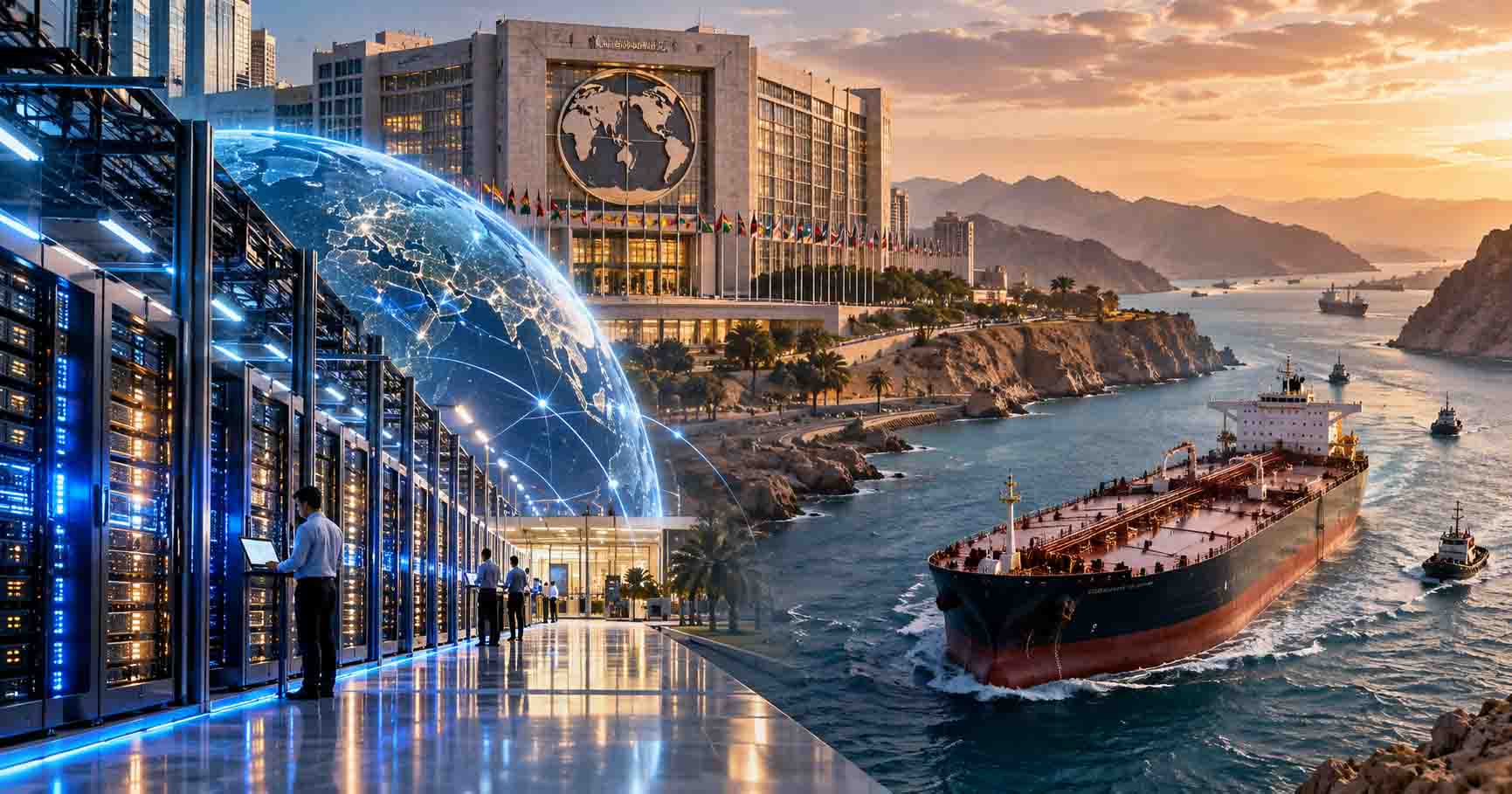
The IMF global growth forecast 2026 has been raised to 3.1%, exposing an increasingly divided world economy: countries benefiting from the artificial intelligence investment boom are expanding, while several Gulf economies are projected to contract sharply under the impact of energy disruptions and restricted shipping through the Strait of Hormuz.
The new outlook suggests that the global economy has so far absorbed much of the Middle East energy shock. But that resilience is highly uneven. AI infrastructure spending is supporting growth across the United States and parts of Asia and Europe, while Saudi Arabia, the UAE, Kuwait, Qatar and Bahrain face economic contractions in 2026.
IMF global growth forecast 2026 rises to 3.1%
The International Monetary Fund now expects global real GDP to expand 3.1% in 2026, up from the 3.0% forecast in July. Growth is projected to accelerate to 3.4% in 2027.
The upgrade comes despite oil prices remaining elevated because of the Middle East conflict and disruption to energy exports and shipping.
Strong investment in artificial intelligence infrastructure has been one of the main forces supporting activity, alongside efforts by governments and companies to draw down inventories, switch suppliers and energy sources, and reduce oil demand.
AI is creating a new group of economic winners
The AI boom is extending well beyond technology companies. Economies supplying semiconductors, hardware and infrastructure for data centers are receiving a direct growth boost from the surge in investment.
South Korea, Malaysia, Mexico and Thailand are among the countries benefiting from AI-related supply chains, while investment in the technology has also helped strengthen forecasts for the United States and some European economies.
But global growth is becoming increasingly concentrated. Just 32 countries now account for 95% of global growth, according to the IMF, compared with 54 countries in its April assessment.
Gulf economies face the other side of the shock
Gulf economies exposed to disruptions in oil and gas production and shipping through the Strait of Hormuz have suffered some of the largest forecast downgrades.
Saudi Arabia’s economy is now projected to contract by 3.3% in 2026, compared with 1.7% growth forecast in July. Its alternative oil export infrastructure through the Red Sea has reduced, but not eliminated, the impact of the disruption.
The IMF expects the UAE economy to contract 3.9%, while Kuwait and Qatar face much deeper declines of 16.7% and 15.6%, respectively.
Bahrain is projected to contract by 11.3%, while Oman stands out as the only GCC economy expected to record positive growth this year.
Why are Kuwait and Qatar taking a larger hit?
The severity of the downturn largely reflects how dependent individual economies are on energy exports through routes affected by the Strait of Hormuz disruption and whether they have alternative infrastructure available.
Countries with fewer alternative export routes have suffered a much sharper hit to energy production and trade, while Saudi Arabia has been able to divert part of its crude flows toward the Red Sea.
The outlook was released as global economic policymakers gathered for the 2026 IMF and World Bank meetings, where energy, debt, artificial intelligence and geopolitical risk are dominating the economic agenda.
When does the IMF expect Hormuz to normalize?
The IMF’s baseline assumes a gradual reopening of the Strait of Hormuz beginning in March 2027, followed by a return to prewar shipping conditions by October 2027.
Its forecasts assume an average oil price of $96 per barrel in 2026 and $87 in 2027.
Under a more severe scenario in which the conflict worsens and oil reaches $130 per barrel through the first quarter of 2027, global growth would be reduced by another 0.2 percentage point in 2026 and 0.5 percentage point in 2027.
US and India hold up while China slows
The IMF expects the US economy to grow 2.3% in both 2026 and 2027, supported by consumption, tax changes and AI investment.
China is forecast to expand 4.5% this year and 4.0% in 2027 as higher energy costs compound weak domestic demand despite strong exports.
India remains the fastest-growing major economy, with GDP projected to rise 7.0% in both years.
AI is also becoming a risk to the outlook
The same technology supporting global growth could become a source of instability if expectations run ahead of actual productivity gains.
In an upside scenario involving faster AI adoption and stronger productivity, the IMF estimates global GDP could be an additional 0.6% higher by 2029.
But a sharp reassessment of AI profitability could weaken investment and asset prices. Combined with higher bond yields, such a scenario could reduce global output by 1.1% by 2028.
A stronger world economy with a widening divide
The headline 3.1% growth figure therefore masks two very different economic stories.
Countries at the center of the AI investment and supply-chain boom are gaining momentum, while economies exposed to the energy shock or outside the new technology value chain are carrying a much greater share of the cost.
The IMF’s October outlook is less a story of a global economy escaping the oil shock than one of that shock being redistributed across an increasingly uneven world.
Sources
International Monetary Fund — World Economic Outlook, October 2026.
Reuters — October 13, 2026 coverage of the World Economic Outlook.


