


Bangkok Meetings Put the Global Economy Through a Three-Way Stress Test
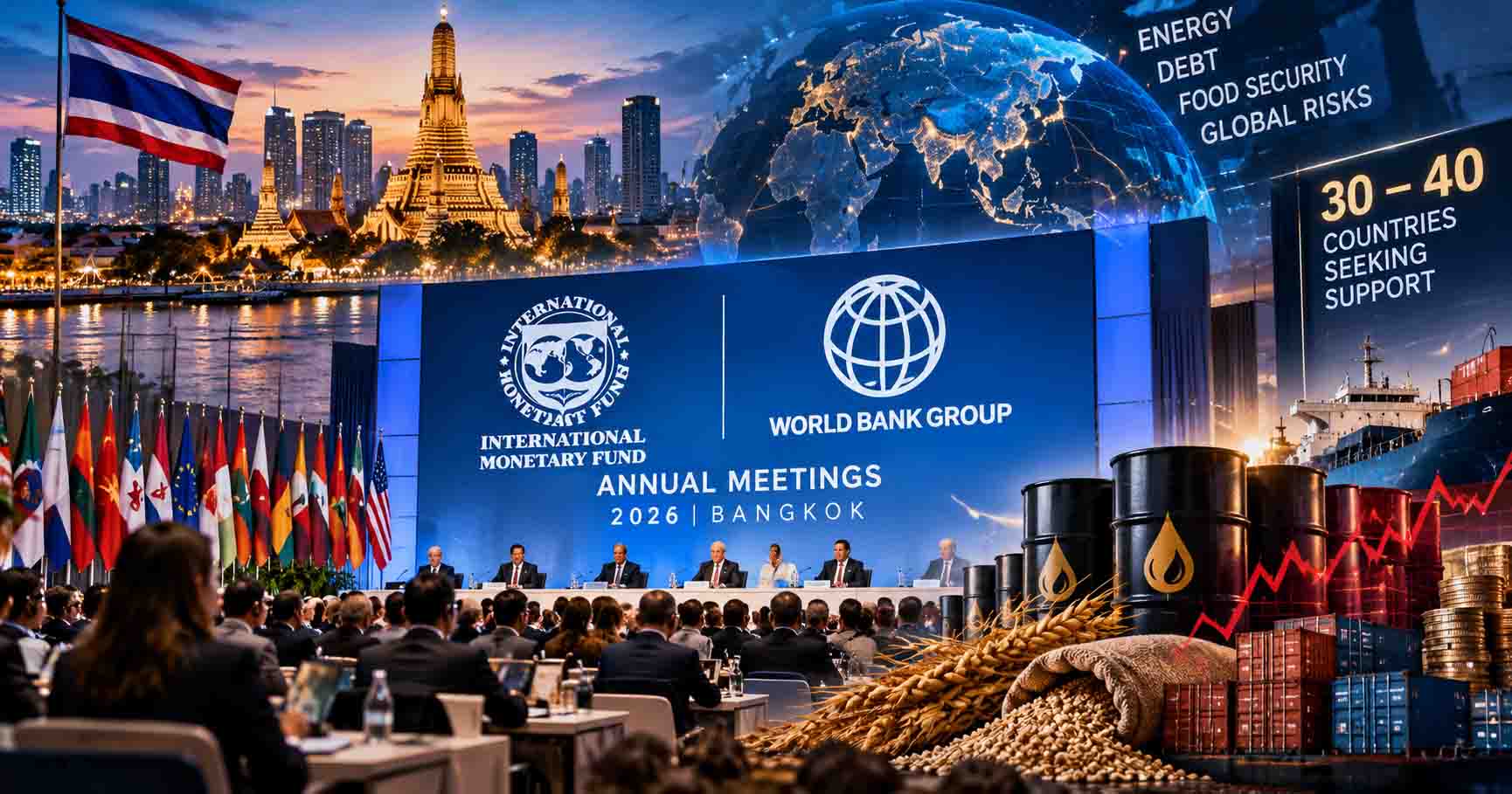
The IMF World Bank meetings 2026 open in Bangkok with the global economy facing a three-way stress test: an unfinished energy shock, increasingly expensive debt and growing pressure on food and government budgets from climate risks.
The challenge is no longer simply whether global growth slows. The more important question is how many overlapping shocks governments can absorb before higher fuel prices, refinancing costs and weaker fiscal buffers begin reinforcing one another.
IMF World Bank meetings 2026 open under a three-way global stress test
The annual meetings bring together finance ministers, central bank governors, development officials and private-sector leaders at a moment when energy, debt and climate risks are increasingly interacting rather than unfolding separately.
The central question for policymakers is no longer only how fast the global economy can grow, but whether governments have enough fiscal and financial room to absorb several shocks at the same time.
An energy shock that has changed shape
The global economy absorbed the initial supply disruption better than many policymakers feared. Strategic reserves, alternative energy routes and demand-management measures prevented a deeper immediate contraction.
But the IMF has warned that the energy shock is not over. Shipping disruptions remain important, inventories eventually need to be rebuilt and winter demand is approaching.
The economic impact now runs beyond crude prices. Diesel, freight, insurance, fertilizers and electricity feed into production costs across multiple industries, turning a geopolitical supply shock into a broader inflation problem.
Debt is becoming more expensive at the worst possible time
Global public debt is approaching 100% of world GDP, while developing economies face roughly $400 billion in external creditor payments during 2026.
About one-third of those payments are interest, leaving governments with less fiscal room to protect households from energy and food shocks or to invest in infrastructure, health and education.
The difficulty is particularly acute for countries refinancing older debt at rates far above those available when the borrowing was originally undertaken.
The most vulnerable countries face several risks at once
Energy-importing economies suffer directly when fuel prices rise. Countries with weaker currencies can face an additional dollar-related cost, while heavily indebted governments are exposed to higher refinancing rates.
When all three conditions occur together — imported energy dependence, high debt and limited fiscal reserves — an external shock can quickly become a budget, currency or cost-of-living problem.
Climate and food risks form the third pressure point
The World Bank is also watching fertilizer prices and the risk of a powerful El Niño episode.
Higher energy costs raise agricultural and transport expenses, while weather disruptions can reduce supply. For countries where households spend a large share of income on food, the combination can become politically and economically difficult very quickly.
Why 30 to 40 countries are talking to the World Bank
World Bank President Ajay Banga said the institution is discussing potential support with 30 to 40 countries facing pressure from energy and commodity costs.
The Bank has a $25 billion crisis window, while countries can potentially redirect about $35 billion from previously approved projects.
Banga said total available capacity could eventually rise toward $100 billion if conditions deteriorate significantly.
The significance is not simply the size of the facility. The number of governments entering discussions indicates that the economic consequences of the conflict are spreading well beyond the countries directly involved.
War on Iran: The U.S. Has Military Superiority — So Why Can’t It End the Conflict?
More lending alone will not solve the problem
Adding debt to already-indebted economies can provide short-term liquidity without necessarily improving long-term resilience.
That is why the development debate is increasingly focused on guarantees, private capital, refinancing and debt restructuring rather than traditional sovereign lending alone.
The World Bank Group says it mobilized a record $112 billion in private capital in fiscal 2026, more than three times its 2022 level.
Yet low-income countries attracted only about $3 billion, exposing one of the central problems in development finance: the economies that need outside investment most are often the hardest places in which to attract it.
Central banks face an uncomfortable trade-off
A renewed energy-driven rise in inflation would complicate plans to lower interest rates.
Cutting too quickly could allow inflation to strengthen again, while keeping rates high for longer would increase borrowing costs and weaken investment, housing and consumption.
This makes sovereign bond markets nearly as important as oil prices in determining how the next phase of the global economy develops.
Is gold investment still an effective hedge against inflation in 2026?
AI creates both growth and energy demand
Artificial intelligence adds another dimension to the debate. Technology investment has supported growth in the United States and economies connected to the AI supply chain, but data centres and computing infrastructure also require vast amounts of electricity and investment.
Bangkok’s agenda therefore connects AI, jobs, private investment and energy rather than treating technology as a separate issue.
What matters during the Bangkok week
Four questions will matter more than the meeting communiqués themselves.
Will higher energy costs force a meaningful downgrade to global growth? Can debt-distressed countries gain relief before financing problems become crises? Can private capital reach low-income economies rather than concentrating in stronger emerging markets? And will central banks be forced to keep interest rates higher for longer?
Why this matters outside financial markets
The consequences ultimately reach households. Oil prices affect transport and electricity. Interest rates affect mortgages, business investment and jobs. Sovereign debt constrains public spending. Fertilizer and weather conditions affect food prices.
The Bangkok meetings are therefore a test of whether global financial institutions can prevent today’s market and energy shocks from becoming a broader growth and living-cost problem in 2027.
Sources
International Monetary Fund – 2026 Annual Meetings and global economic outlook.
Reuters – World Bank crisis-aid discussions and developing-country debt pressures.


