

Putin outlines Russia’s political and economic priorities at the St. Petersburg International Forum
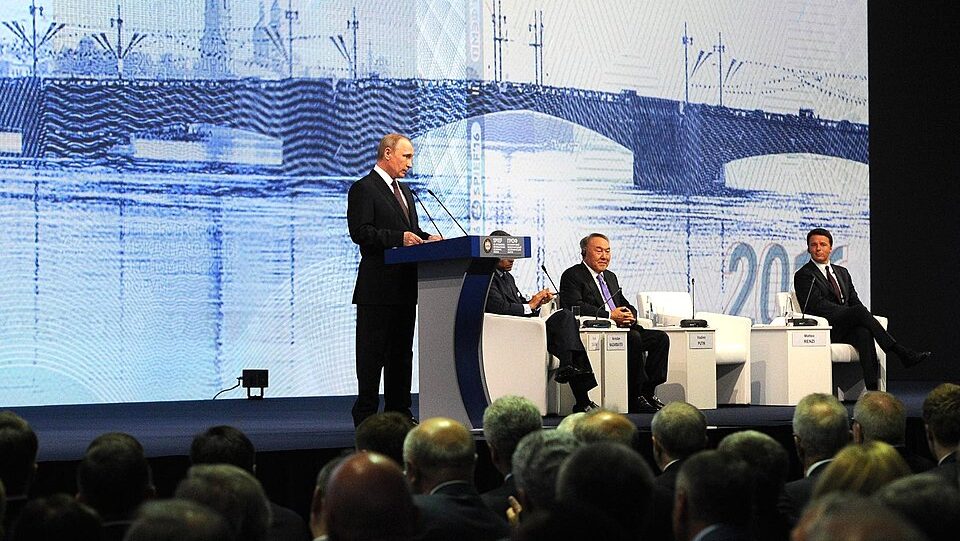
SPIEF 2026: Putin outlines Moscow’s vision for international security and the global economic order
Russian President Vladimir Putin’s statements at the St. Petersburg International Economic Forum this year formed a comprehensive presentation of Moscow’s vision on key international issues, from the war in Ukraine and relations with Iran, to the future of the global economy, Western sanctions, and the role of the BRICS group.
While some statements focused on security and political issues, others carried economic and strategic messages reflecting Russia’s perception of ongoing shifts in international power balances.
Ukraine at the forefront of messages.. Eradicating Nazism
The Ukrainian file occupied a large part of Putin’s statements, as he affirmed that some goals of Russia’s military operation can be achieved through the negotiation track, indicating that Moscow sees the possibility of addressing some political issues through negotiations.
The Russian president said his country would seek to achieve some of its goals “through the negotiation track,” adding that this includes what he described as “eradicating Nazism,” expressing hope that the international community would contribute to this path.
In the same context, Putin criticized what he considered the rehabilitation of figures associated with the Nazi era in Ukraine, considering that such steps represent one of the reasons for the deep disagreement between Moscow and Kyiv.
Meeting Zelensky: No point for now
Regarding proposals for a direct meeting with Ukrainian President Volodymyr Zelensky, Putin expressed skepticism about the feasibility of such a meeting at the current stage.
He said: “I see no point in a meeting for now,” considering that Moscow’s priority is to reach understandings and clear documents that can be built upon in the future.
He added that Russia is not looking for “temporary agreements” or short-term arrangements, but for settlements that extend to a “long-term historical perspective.”
He also revealed that he had seen a letter from Zelensky, and considered that some of its contents contained “elements of rudeness,” pointing out that moving political discussions into the public domain does not help create conditions for direct meetings.
At the same time, he affirmed that Russian forces continue their military operations, indicating that Moscow is moving towards achieving what he described as the “complete liberation of Donbas” gradually.

Iran and the United States.. Attacking Tehran unjustified
On the Iranian file, Putin affirmed that he does not see Iran as having taken any provocative steps that would justify the recent US attack on it.
He said: “I do not see any provocations from Iran,” while expressing hope that the current truce between Washington and Tehran would turn into long-term peace.
He added that the decision to halt hostilities represents “the only correct decision,” considering that stabilizing the situation serves the interests of all parties.
He also denied that Russia provided direct military support to Iran during the recent confrontation, explaining that Russian support was limited to political and diplomatic aspects.
In contrast, he stressed that Moscow supports Iran’s right to develop peaceful nuclear programs, noting continued cooperation between the two countries on nuclear energy projects, including work on additional units at the Bushehr nuclear power plant.
Criticism of Europe and sanctions
In another axis, Putin directed sharp criticism at European and Western policies, considering that the European continent is paying an increasing economic price as a result of its political choices.
He said that some European elites contribute to escalating international tensions, adding that “aggressive rhetoric” and provoking crises have become part of the European political scene.
He also believed that Western sanctions have harmed the countries that imposed them as much as they targeted Russia, pointing out that the Eurozone has suffered significant economic losses in recent years.
The Russian president also touched on the issue of freezing Russian assets and reserves, considering that these measures have caused permanent damage to the status of the dollar and the euro.
He said: “All countries without exception can at any moment lose access to their legal assets placed in dollars or euros,” calling for the development of more independent alternative financial systems.

Global economic transformations
Putin linked these developments to what he described as the biggest structural shift the world has seen in decades. He said the world is not going through an ordinary transitional phase, but is witnessing “a change in the global development model itself,” considering that centers of economic power are gradually moving towards new regions outside the traditional Western framework.
In this context, he spoke about what he called the “race for sovereignty,” affirming that countries are increasingly seeking to protect their economic interests and reduce their dependence on traditional financial centers.
He added: “The race for sovereignty has begun and gained momentum,” pointing out that this trend is not only about politics, but also includes the economy, technology, and productive capacities.
BRICS and new power balances
Putin paid special attention to the BRICS group, considering it one of the most prominent indicators of the ongoing shift in the global economy.
He noted that the group’s share of world trade has doubled in recent decades, affirming that the volume of trade exchange between its members has exceeded one trillion dollars annually.
He said that economic growth rates in BRICS countries clearly exceed those of G7 countries, citing estimates indicating growth of over 4% annually for the group’s countries, compared to only about 1.5% for Western industrialized countries.
He added that global trade has become more diverse, with the expanded use of national currencies and the emergence of new logistical and financial paths that reduce dependence on traditional intermediaries.

Russian economic indicators
On the domestic front, Putin presented a set of economic indicators that he said reflect the stability of the Russian economy despite external challenges.
He explained that Russia’s public debt amounts to about 16.4% of GDP, a level much lower than debt rates recorded in several major European economies.
He also noted the continued decline in inflation rates, with expectations that the indicator will approach 5.2% during the current year.
At the conclusion of his remarks, he extended an invitation to investors and businessmen from various countries around the world to enhance their investments in Russia, affirming that the Russian economy still retains attractive factors and growth opportunities in a number of sectors.
🚨Putin’s SPIEF 2026 speech declared the start of multipolar world
🔸New global power centers are forging their own paths — the world is undergoing its biggest shift away from Western-centric order.
🔸Rise of BRICS: BRICS now holds 40% of world GDP (G7 under 29%) and its…
— Sputnik India (@Sputnik_India) June 5, 2026
Broader political messages
Putin’s statements were not limited to international and economic issues, as he also touched on internal and personal matters, including talk about age and political leadership.
He said that the criterion for judging leaders is not related to age but rather to “ability to work and efficiency,” affirming that many politicians around the world continue to perform their duties at advanced ages.
He also indicated that it is too early to talk about the 2030 Russian presidential elections, considering that such decisions are linked to the circumstances of the coming period.
Overall, Putin’s statements at the St. Petersburg International Economic Forum reflected a Russian vision combining security, political, and economic files, presenting a vision of Moscow’s position in a world witnessing rapid changes in international and economic power balances.
Read also: