

Yemen Saudi Conflict Escalates: Houthi Attacks Return as Fighting Spreads
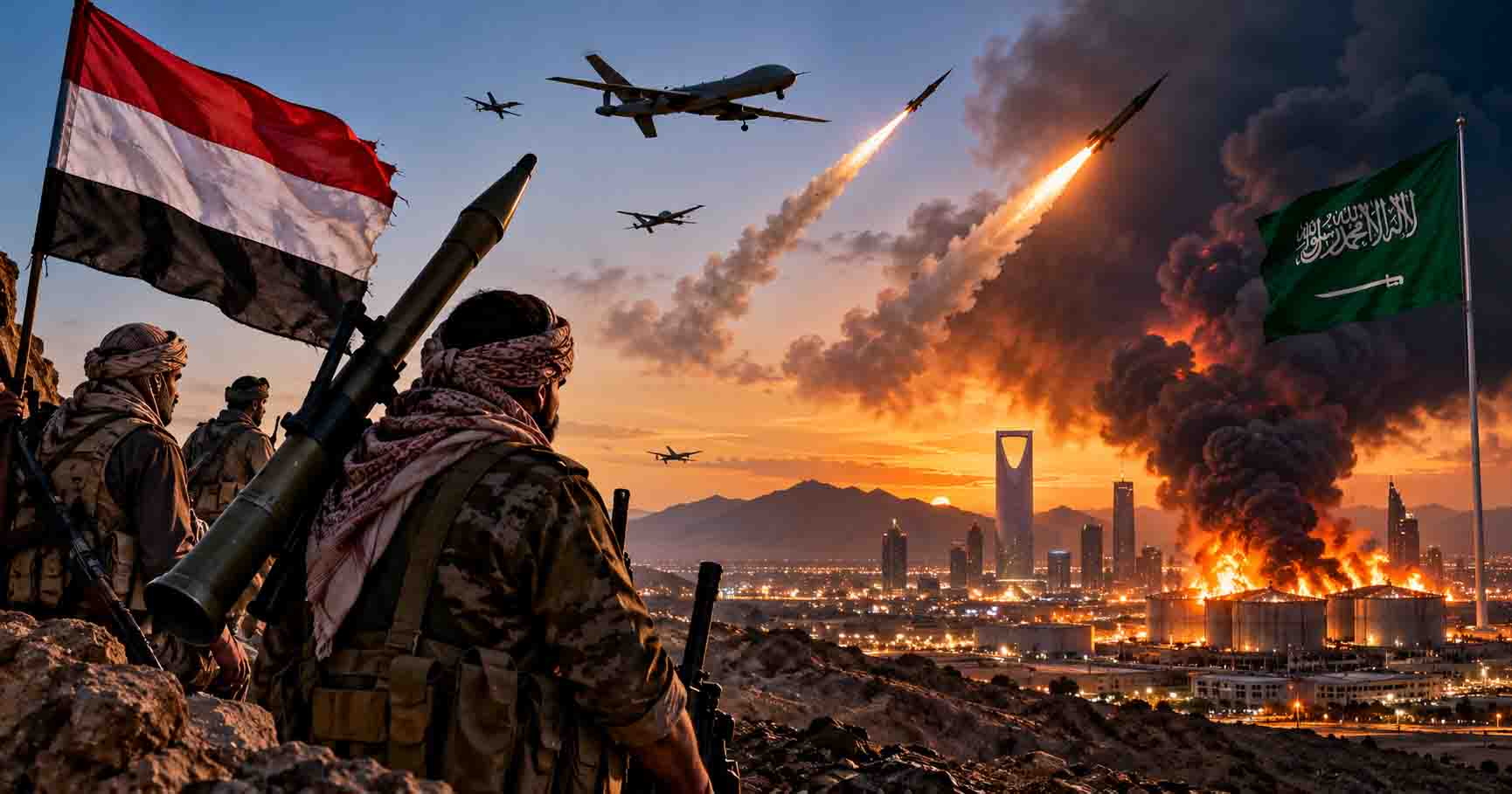
The Yemen-Saudi conflict entered a more dangerous phase on September 9, 2026, as Houthi attacks continued across southern Saudi Arabia and military operations expanded on multiple fronts inside Yemen.
The latest escalation follows attacks on cities and energy facilities in southern Saudi Arabia that injured 73 people, according to Saudi authorities, while Yemeni government forces expanded operations against the Houthis across several fronts. International and regional actors have warned that the fighting could develop into a broader confrontation.
Yemen-Saudi Conflict: Is Open Warfare Returning?
The Saudi-led coalition said the Houthis launched ballistic missile and drone attacks on areas of southern Saudi Arabia for a second consecutive day, including Abha, Khamis Mushait and Jazan.
The latest attacks followed a broader wave the previous day targeting civilian and economic sites and energy facilities in Abha, Khamis Mushait, Jazan and Najran.
Saudi authorities said the September 8 attacks injured 73 civilians, including women and children. The strikes also sparked fires at several energy sites and temporarily disrupted some operations.
Saudi authorities issued emergency alerts in several southern areas during the attacks before later announcing that the immediate threat had passed in the affected locations.
The Houthis, for their part, said their operations targeted Saudi energy facilities and military sites, including Aramco facilities and an air base in Khamis Mushait.
Saudi Arabia Vows Response as Houthis Link Attacks to Yemen War
Riyadh said it would take the necessary measures to defend its territory, population and infrastructure, while the Saudi-led coalition described the Houthi attacks as a dangerous escalation and threatened operational measures against the sources of the threat.
The developments reopen one of the most dangerous fronts in the war in Yemen, after a period of relative calm that began in 2022 sharply reduced cross-border attacks and large-scale military operations.
The Houthis said their attacks on Saudi Arabia were carried out in response to military operations against areas under their control in Yemen.
Yemen’s internationally recognized government, meanwhile, says its current operations are aimed at retaking Houthi-held territory and restoring state institutions in the capital, Sanaa.
Yemen Fronts Shift From Al Jawf to Marib and Taiz
As attacks continued inside Saudi Arabia, military operations expanded across several fronts in Yemen.
Government forces said they had carried out operations in Al Jawf, Al Bayda, Taiz and Marib in recent days, amid clashes with Houthi forces and exchanges involving airstrikes, missiles and drones.
In Al Jawf, government forces reported advances in the Al Yatmah area and said military operations were continuing, while fighting was also reported around strategic positions and routes leading toward Sanaa.
Government forces also announced an operation against Houthi positions south of Marib on September 9, saying it was launched in response to attacks on civilians and government troops.
Operations continued on several fronts in Taiz, where government forces said they struck Houthi positions and command centers.
Accounts of territorial control remain contested, with both sides claiming gains and losses inflicted on the other. Many battlefield developments remain difficult to verify independently.
Declared Objective: Retaking Sanaa
Statements by Yemeni government military officials have raised the stakes of the current campaign, with officials saying the ultimate objective is to retake Sanaa, which has been under Houthi control since 2014.
Al Jawf is particularly important in those calculations because of its location and links to northern provinces and routes leading toward Sanaa and Saada.
Al Bayda is also strategically significant because of its central location and connections to several provinces, while the Marib and Taiz fronts add further pressure on Houthi positions.
Any push toward Sanaa would move the conflict into a more complex military phase, particularly if the current advances develop into a broader attempt to alter front lines that have largely stabilized over years of war.
Death Toll From Al Hazm Prison Strike Rises
In one of the deadliest incidents of the latest escalation, the death toll from the collapse of a prison in Al Hazm, in Al Jawf province, rose to at least 23, including a child, with seven others injured, according to reports citing Houthi authorities.
The Houthis accused the Saudi-led coalition of carrying out the strike on the site. Saudi Arabia had not confirmed responsibility for the attack in the reporting available.
An initial toll had put the number of dead at seven before the figure rose as search and rescue operations continued.
The incident came amid a wave of reciprocal strikes and military operations across several Yemeni provinces, increasing risks to civilians as the fighting expands.
More Than 21,000 Displaced as Fighting Expands
The military escalation is also producing a growing humanitarian impact inside Yemen.
Recent estimates indicate that more than 21,000 people have been displaced as fighting intensifies, particularly in Taiz and areas along the western coast.
The World Health Organization has also reported hundreds of people killed or injured since late August as fighting intensified.
The latest displacement comes in a country already facing a prolonged humanitarian crisis after years of war, political division and deteriorating basic services.
United Nations Warns of Wider Conflict
The UN special envoy for Yemen condemned the Houthi attacks on Saudi Arabia, warning that cross-border strikes could broaden the conflict, put civilians at risk and undermine political efforts.
The warnings carry added significance because the current round of fighting represents one of the most serious escalations since the UN-brokered truce in 2022.
Although the formal truce expired, understandings that followed helped limit large-scale military operations and cross-border attacks for an extended period.
The latest developments are putting that relative calm under renewed pressure, with attacks returning to Saudi territory as multiple fronts inside Yemen become active again.
Pakistan Becomes Part of the Regional Calculations
Pakistan’s position has added a new regional dimension to the escalation.
Pakistan’s defense minister said Houthi attacks on Saudi Arabia could trigger obligations linked to mutual defense arrangements, as Islamabad continues mediation efforts aimed at reducing regional tensions.
According to Reuters, Pakistan conveyed a Saudi message to Iran calling for the Houthis to be reined in, while Tehran says it does not directly control the group’s decisions.
Pakistan’s position suggests that continued attacks inside Saudi Arabia could prompt countries with security and defense ties to Riyadh to reassess their role in protecting Saudi territory.
At the same time, public statements indicate that any potential Pakistani military support would focus on defending Saudi territory rather than participating in combat operations inside Yemen.
Bab al-Mandab Returns to Center of Energy Security Concerns
The significance of the escalation extends beyond Saudi Arabia and Yemen, as the fighting coincides with mounting pressure on regional maritime routes.
With shipping through the Strait of Hormuz under increasing pressure because of the confrontation between the United States and Iran, routes through the Red Sea and Bab al-Mandab have become even more important for energy exports and international trade.
An escalation in Yemen could therefore increase pressure on two strategic maritime corridors at the same time, the Strait of Hormuz to the east and Bab al-Mandab and the Red Sea to the west.
The risk becomes more serious if attacks on Saudi energy facilities coincide with threats to maritime traffic, as simultaneous disruptions to production and export routes could add further pressure to global oil markets.
Oil Above $100 Raises the Stakes
The Saudi-Houthi escalation coincided with Brent crude trading above $100 a barrel, as markets reacted to growing concerns over energy supplies and maritime routes across the Middle East.
The increase is not driven by the Yemen front alone. It is part of a broader regional crisis involving the US-Iran confrontation, attacks on oil tankers and disruption to shipping through the Strait of Hormuz.
Attacks on Saudi energy facilities, however, add another layer of risk because the kingdom is one of the world’s largest oil producers and exporters.
Growing threats in the Red Sea and Bab al-Mandab could also put additional pressure on oil transportation options if disruptions in the Strait of Hormuz continue.
Could the Yemen War Return to Open Conflict?
The key indicator in the latest developments is that the escalation is no longer confined to a single front.
The Houthis are carrying out attacks on Saudi territory, while Yemeni government forces are operating in Al Jawf, Marib, Al Bayda, Taiz and other areas. Air and missile strikes are also intensifying, while displacement and casualties are rising.
At the same time, the conflict has become more closely connected to the wider regional confrontation involving Iran, the United States and their respective allies.
Assessment: Continued cross-border attacks represent the most sensitive factor in the next phase. If attacks on Saudi Arabia become sustained and Riyadh responds by expanding military operations inside Yemen, prospects for a rapid return to de-escalation could diminish, and the current round could develop into a broader multi-front confrontation.
If the Saudi response remains limited and regional and international mediation succeeds in containing the attacks, however, the political track could remain open despite the intensity of the current escalation.
What to Watch Now
- Saudi Arabia: The nature of its response to continued Houthi attacks and whether military operations expand.
- Al Jawf: The direction of the fighting and whether government forces can consolidate additional gains.
- Marib, Al Bayda and Taiz: Whether government forces can maintain pressure across multiple fronts simultaneously.
- Sanaa: Whether the stated objective of retaking the capital develops into a broad military operation.
- Pakistan: Whether continued attacks on Saudi Arabia lead to additional defensive measures.
- Bab al-Mandab: Any new threats to ships or commercial traffic through the Red Sea.
- Civilians: Changes in displacement and casualty figures as fighting expands.
- Oil: The impact of any new attacks on Saudi energy facilities on global prices.
Conclusion
Recent developments indicate that the Yemen war is facing its most serious test after years of relative calm. Houthi attacks have returned to Saudi territory, government forces have opened several fronts inside Yemen, and energy facilities and maritime routes are increasingly becoming part of the conflict’s strategic calculations.
With Pakistan becoming involved in diplomatic and defense discussions and the United Nations warning of a wider conflict, the Yemen crisis is becoming increasingly intertwined with the broader regional confrontation.
The nature of the Saudi response, the direction of fighting in Al Jawf, Marib, Taiz and Al Bayda, and any further attacks on Saudi territory or energy infrastructure will be key indicators of whether the current escalation remains limited or marks a return to open warfare.