US Food Prices: What Actually Got More Expensive on Store Shelves?
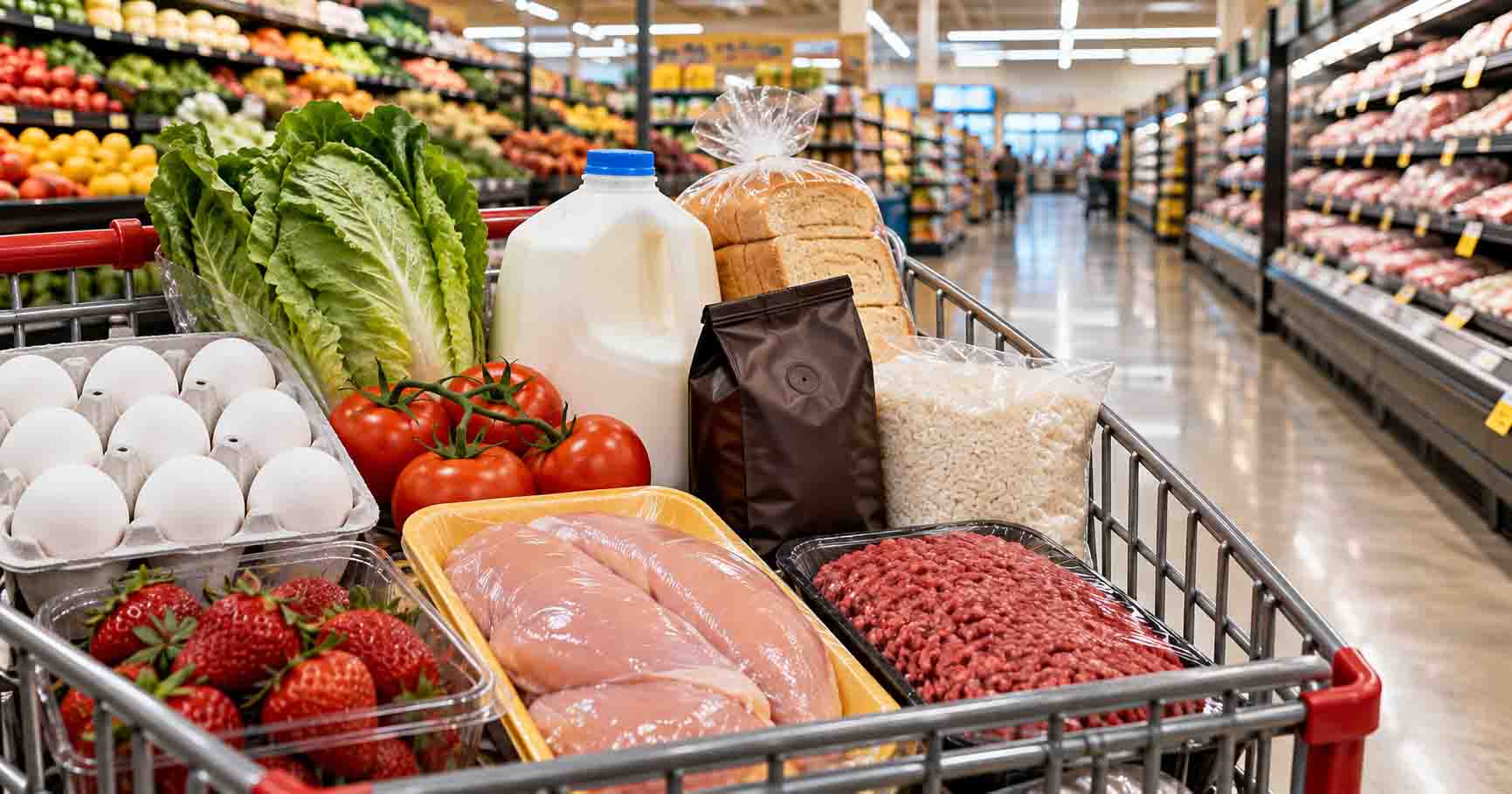
US food prices present a surprising contradiction for shoppers: the official grocery index fell 0.1% in September 2026, yet rice, coffee, fresh fruit, lettuce and tomatoes all became more expensive while consumers were still paying elevated prices across much of the shopping basket.
So how can grocery inflation fall while the checkout total still feels high? The answer becomes clearer when the headline number is broken down product by product and when inflation rates are separated from the actual dollar prices consumers see on store shelves.
US food prices: groceries fell 0.1%, but that is only the average
The Bureau of Labor Statistics reported that the food-at-home index declined 0.1% from August to September but remained 1.8% higher than a year earlier.
Total food prices were 2.5% higher year over year, while prices for food away from home were up 3.5%.
A small decline in the overall grocery index therefore does not mean prices returned to earlier levels or that every item became cheaper.
Rice and coffee became noticeably more expensive
The rice index increased 1.1% in September and was 7.1% higher than a year earlier.
Coffee prices rose 0.9% for the month and 7.1% over 12 months, while roasted coffee increased 1.8% in September and 7.2% year over year.
For households that buy both products frequently, those increases can matter far more than the slight decline in the overall grocery index.
Fresh produce is another pressure point
Fruit and vegetable prices increased 0.5% during September and 3.7% over the year.
Fresh fruit rose 0.8% monthly and 4.9% annually.
Apple prices increased 1.0% in one month and 7.5% from a year earlier, while lettuce rose 3.9% in September and tomatoes increased 1.4%.
What happened to actual lettuce and strawberry prices?
BLS average retail price data provide another way to see what shoppers encountered.
The national average price of iceberg lettuce increased from $1.471 per pound in August to $1.636 in September, an 11.2% monthly jump.
A 12-ounce dry pint of strawberries rose from $2.578 to $2.840, an increase of 10.2%.
Those figures do not mean every store changed prices by the same amount, but they show why some shoppers can experience far more inflation than the national grocery average.
Ground beef got cheaper this month — but remains expensive
The beef and veal index fell 1.0% in September, while uncooked ground beef declined 0.8%.
However, ground beef remained 5.4% more expensive than a year earlier.
In BLS dollar-price data, regular ground beef fell from an average $6.923 per pound in August to $6.792 in September, a 1.9% monthly decline, while remaining 7.4% above September 2025.
Milk fell sharply from August
The milk index declined 2.0% in September.
The average price of a gallon of whole milk fell from $4.229 in August to $4.106 in September, a 2.9% decrease.
Yet the milk CPI remained 2.3% higher than a year earlier, illustrating the difference between a monthly decline and a return to older price levels.
What happened to egg prices?
The egg index fell 1.3% in September and was 20.6% below its year-earlier level.
Meanwhile, the national average retail price for a dozen large Grade A eggs was $2.272 in both August and September.
This is not a contradiction: CPI indexes and average dollar prices use different statistical methods and are designed to answer different questions.
Some chicken prices moved higher
While the broader meat, poultry, fish and egg index fell, some chicken items became more expensive.
A whole fresh chicken increased from an average $2.012 per pound to $2.064, a 2.6% monthly rise.
Boneless chicken breast increased from $4.173 to $4.203 per pound.
What are shoppers paying for rice, bread and coffee?
Long-grain white rice averaged $1.118 per pound in September, up from $1.111 in August.
White bread averaged $1.830 per pound compared with $1.823 a month earlier.
Ground roasted coffee averaged $9.332 per pound, up from $9.299 in August.
Why CPI and shelf-price changes are not identical
An average retail price tells shoppers the estimated price level for a specific product and unit in a particular month.
A CPI index is designed to measure price movement across comparable products over time.
That is why Profile News uses CPI percentages when discussing inflation and BLS average-price data when showing what shoppers are actually paying in dollars.
Why groceries can still feel painfully expensive
Households do not purchase the statistical average.
A family that regularly buys coffee, rice, fresh produce and seafood can face much higher personal food inflation than a household whose purchases are concentrated in products that recently became cheaper.
And when inflation slows, prices generally stop rising as quickly; they do not automatically return to their old levels.
Gasoline adds pressure to the same household budget
The grocery index is only one part of household spending.
Gasoline prices jumped 9.1% in September and accounted for more than half of the monthly increase in the overall US consumer price index.
That means families can feel greater financial pressure even during a month when the grocery index itself falls slightly.
What does a real GFS store show?
The Gordon Food Service Store page for Fishers, Indiana currently lists a 30-count tray of large eggs at $2.99, fresh beef eye of round at $4.99 per pound and boneless pork loin at $1.79 per pound.
Those prices should not be compared directly with national BLS averages because they are specific to one retailer, location, package size and purchasing format, including bulk products and store promotions.
They are useful as a real-world retail snapshot, not as a measure of nationwide inflation.
Will US grocery prices fall soon?
The USDA’s latest available Food Price Outlook does not forecast a broad drop in grocery prices during 2026.
It expects food-at-home prices to average about 2.4% higher in 2026 than in 2025.
Beef and veal are projected to increase about 9.4% for the year, with tight cattle supplies continuing to support prices.
The real question for shoppers
The September data show why one headline inflation number can be misleading at the household level.
The overall grocery index fell slightly, but the products inside an individual shopping cart moved in very different directions.
For consumers, the most useful question is therefore not simply whether “grocery prices went up,” but which foods their household buys most often and how those specific prices are changing.
Read Also
Sources
- U.S. Bureau of Labor Statistics — Consumer Price Index, September 2026
- Gordon Food Service Store — Fishers, Indiana current store listing