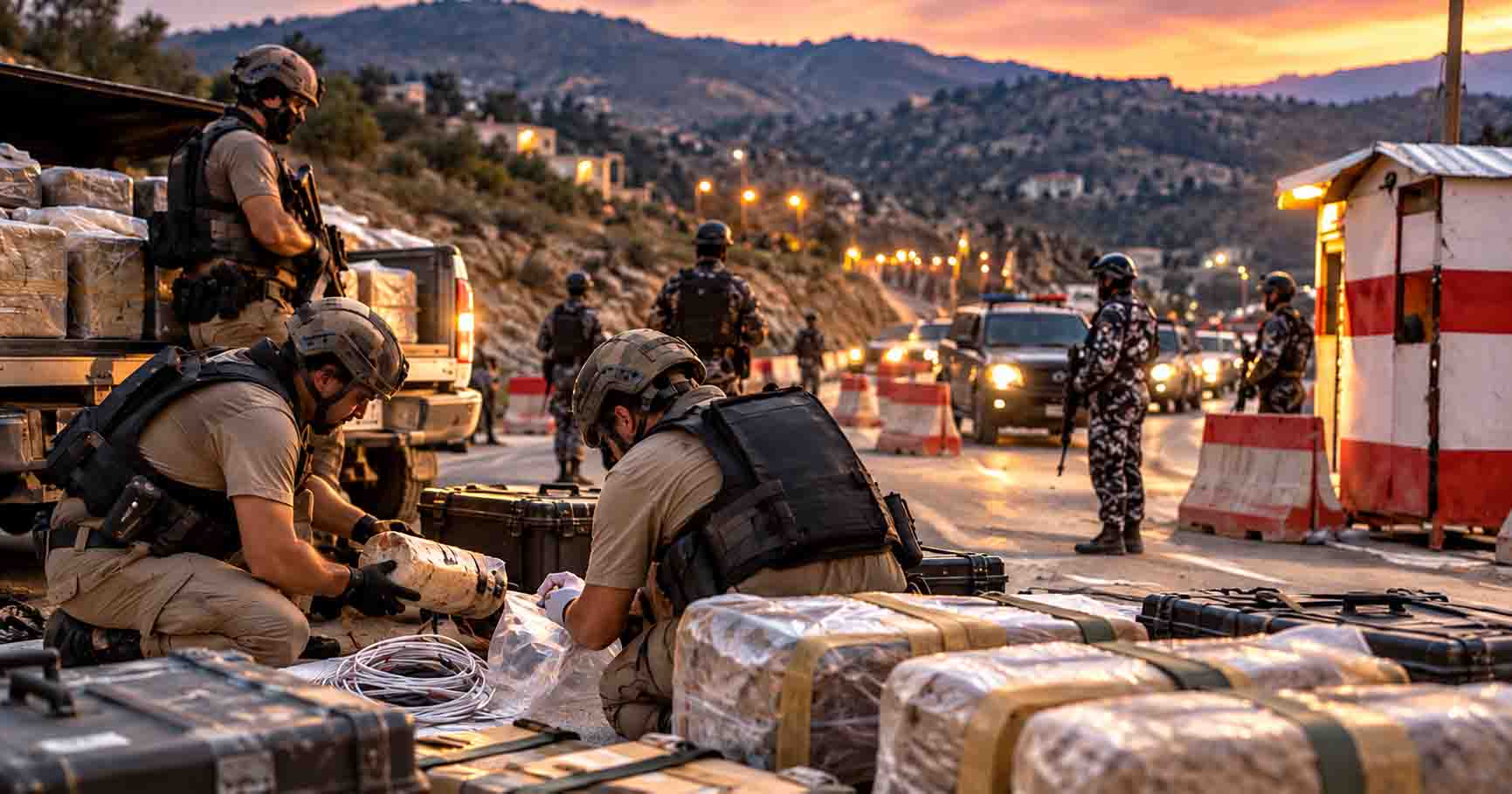
Dahr al-Baidar explosives are no longer simply a security seizure on the highway between the Bekaa Valley and Beirut. Days after authorities intercepted a vehicle carrying hundreds of kilograms of explosives, Hezbollah lawmaker Hassan Fadlallah said the vehicle and its cargo belonged to the group and demanded their return. U.S. Secretary of State Marco Rubio then directly raised the case with President Joseph Aoun and urged that the explosives not be returned.
The Lebanese government, meanwhile, says the investigation is continuing to identify everyone involved and those behind the shipment, while Aoun has stressed that the army and security forces are continuing to confiscate weapons and ammunition and combat smuggling.
Between Hezbollah’s account that the materials were intended for use against Israeli forces and concerns raised by the large quantities of C-4 and the shipment’s route toward Beirut, no final judicial ruling has yet established what the explosives were intended for.
Dahr al-Baidar explosives: How did the case begin?
The case began when security forces stopped a vehicle at the Dahr al-Baidar checkpoint on the main highway linking the Bekaa Valley with Greater Beirut.
Prime Minister Nawaf Salam said on Oct. 12 that the vehicle was traveling from the Bekaa toward Beirut and was carrying hundreds of kilograms of explosive material, including highly explosive C-4.
Salam praised the security forces that seized the shipment and referred the two people in the vehicle to the relevant authorities for questioning.
According to subsequent Lebanese reports, the interception took place on Oct. 5, before the case expanded into a broader judicial and political issue over the following days.
How much explosive material was seized?
Judicial officials told the Associated Press that the total amount of material seized was about 780 kilograms.
According to the same source, the shipment included 250 kilograms of TNT and 250 kilograms of highly explosive C-4 plastic explosive, along with other materials.
Lebanese media reports have cited differing estimates and details regarding the contents of the shipment. Profile News therefore relies on the figures reported by AP, citing judicial officials, for the overall quantity and the amounts of TNT and C-4.
What did the two detainees tell investigators?
According to judicial officials who spoke to AP, the two detainees said they had been instructed to transport the materials from the Baalbek area toward Beirut and that they did not know their ultimate intended use.
The officials said the detainees were supposed to deliver the shipment to a person south of Beirut whom they identified by the nom de guerre “Zulfiqar.”
Information Minister Paul Morcos said the two detainees had been referred to the judiciary and that security agencies would continue pursuing others involved in the case.
The detainees’ statements remain part of the investigation and do not constitute a final judicial finding.
Nawaf Salam: “No leniency and no turning a blind eye”
Prime Minister Nawaf Salam sharpened the government’s position by stressing that the investigation would not stop with the two detainees.
Salam said the government would expand the investigation to identify everyone involved in what he described as a “criminal operation,” determine who was behind them, uncover their plans and objectives, and refer all those involved to the judiciary.
He said the government would deal firmly with any weapons outside legitimate state authority, whether in their possession, transport or use.
Salam also pointed to concerns raised by the discovery of C-4, noting that the explosive has been used in political assassinations in Lebanon’s modern history.
Were the explosives intended for assassinations inside Lebanon?
No judicial ruling or official finding has so far established that the shipment was intended for an assassination or to target figures inside Lebanon.
Concerns emerged because of the nature of the materials and their route toward the Beirut area, but they remain hypotheses raised in political and media debate until the investigation determines the shipment’s final destination and intended use.
Hezbollah has explicitly denied that the shipment was connected to domestic operations.
Fadlallah says the vehicle and explosives belonged to Hezbollah
On Oct. 15, the case entered a new phase when Hassan Fadlallah, a member of Hezbollah’s Loyalty to the Resistance parliamentary bloc, said the vehicle and the materials inside it belonged to Hezbollah.
Fadlallah said the group contacted the security authorities from the moment the vehicle was stopped and informed them that it belonged to the “resistance” and that the materials inside were, in his words, capabilities intended to confront Israeli forces.
Fadlallah demanded the immediate release of the detainees and the return of the vehicle and its contents.
He also said Hezbollah had tried to address the matter away from media and political controversy before it became public.
MP Hassan Fadlallah: – From the moment the vehicle was stopped, the resistance contacted the relevant authorities and informed them that the vehicle and the materials inside were capabilities intended to confront the occupation, and demanded their return. – We tried to address the matter away from any media or political controversy, out of concern for calm at home, but some parties are working to create a dispute that benefits only the enemy. #وقائع
— وقائع (@waqa2e3) October 15, 2026
What does Hezbollah say the explosives were intended for?
Fadlallah said the group’s military capabilities were directed exclusively against Israel.
A Hezbollah official and a Lebanese security source told Reuters that the seized materials were intended for use in explosive drones targeting Israeli forces.
That remains the account provided by Hezbollah and the security source regarding the intended use of the materials, while Lebanon’s judiciary has not yet announced a final conclusion in the investigation.
Fadlallah rejects allegations of preparations for assassinations
Fadlallah rejected attempts to link the shipment to possible assassinations or domestic operations and criticized what he described as a political campaign aimed at fueling fear and division in Lebanon.
He also objected to measures taken against the group and to calls for the case to be referred to the Judicial Council.
Fadlallah warned against continuing what he described as measures targeting the “resistance,” while the government maintains its decision that weapons and military activity should remain under state institutions.
Why has the case become directly linked to the weapons-control issue?
The shipment was seized at a time when the Lebanese state is seeking to expand its authority over weapons and the movement of ammunition inside the country.
The Cabinet banned Hezbollah’s military activities on March 2, 2026, after the group fired rockets toward Israel during the regional war.
Hezbollah has refused to relinquish its weapons as long as Israeli forces remain on Lebanese territory and Israeli operations continue in the south.
Profile News previously covered the debate over state control of weapons and Hezbollah’s position amid the dispute over the future of the group’s military capabilities.
Rubio directly enters the Dahr al-Baidar explosives case
The case took on an international dimension on the evening of Oct. 15 when U.S. Secretary of State Marco Rubio spoke by phone with President Joseph Aoun.
A U.S. State Department official told Reuters that Rubio discussed with Aoun the confiscation of hundreds of kilograms of explosives belonging to Hezbollah.
According to the U.S. official, Rubio urged Lebanese authorities to hold accountable those who ordered, financed and directed the shipment.
He stressed that returning the seized materials to Hezbollah “should be out of the question.”
Washington also calls for Lebanese-Israeli military communication
The U.S. official said Rubio also urged direct military-to-military communication between the Lebanese and Israeli armed forces to reduce the risk of friction and escalation.
The request comes as Israeli operations continue in southern Lebanon and disputes persist over Israeli withdrawal and the future of Hezbollah’s weapons.
What did Aoun say after his call with Rubio?
The Lebanese presidency’s official statement did not mention the Dahr al-Baidar shipment or Hezbollah by name.
It said Aoun told Rubio that the army and security forces were fully carrying out their duties in implementing decisions to prevent armed displays, confiscate weapons and ammunition, and combat smuggling.
Aoun added that measures taken in recent days were part of that effort and that judicial authorities were pursuing all cases referred to them without leniency or favoritism.
At the same time, Aoun asked Rubio to pressure Israel to halt operations against southern Lebanese villages and towns, stop land-clearing activities and allow farmers to reach their land.
Will the case be referred to the Judicial Council?
Justice Minister Adel Nassar has called for the Dahr al-Baidar case to be referred to the Judicial Council and submitted a draft decree to that effect.
However, the issue was not resolved during Thursday’s Cabinet meeting.
Information Minister Paul Morcos said the government had not taken a decision on referring the case to the Judicial Council because the draft decree had not been placed on the Cabinet agenda and had not yet been formally presented to ministers.
He added that the appropriate steps would be taken once the proposal reaches the government.
Why is referral to the Judicial Council sensitive?
The Judicial Council is a special court that handles certain cases involving the internal or external security of the state, and referral to it carries significant political and judicial weight.
The justice minister’s proposal therefore became another point of dispute after Fadlallah criticized it and warned of its consequences.
As of the morning of Oct. 16, no final government decision had been issued referring the Dahr al-Baidar case to the Judicial Council.
Is there a connection to an explosives shipment from Syria?
Separately from the Dahr al-Baidar case, the Lebanese Army announced the seizure of another shipment weighing about 200 kilograms that was being smuggled from Syria into the border town of al-Qasr in northeastern Lebanon.
According to AP, the smugglers fled toward Syrian territory after being discovered.
No official finding has so far established that the shipment from Syria was connected to the Dahr al-Baidar explosives.
The two cases should therefore be treated separately unless judicial or security evidence emerges linking them.
Why have Hezbollah’s supply routes become more sensitive?
Reuters says Hezbollah’s traditional supply route through Syria suffered a major setback after the fall of Bashar al-Assad’s government in late 2024.
Since then, Syria’s new authorities have repeatedly announced the seizure of weapons near the border that they said were destined for Hezbollah.
In Lebanon, the army continued during 2025 to seize and destroy Hezbollah weapons and storage facilities in the south as part of the state’s plan to expand its authority over weapons, before the new war affected implementation of that process.
Will the state return the explosives to Hezbollah?
That is now the most sensitive question in the case.
Hezbollah is demanding the return of the vehicle and materials and the release of the detainees, saying the shipment was part of its military capabilities intended to confront Israeli forces.
The government, meanwhile, says the investigation is continuing and maintains its policy of bringing weapons under the authority of state institutions, while Washington has explicitly told Aoun that returning the explosives to Hezbollah should be out of the question.
As of the morning of Oct. 16, Lebanese authorities had not announced that the seized materials would be returned to Hezbollah.
What has been established and what remains under investigation?
Hezbollah’s ownership of the vehicle and materials has now been publicly acknowledged by the group itself following Fadlallah’s statement.
The seizure of hundreds of kilograms of explosive material, the detention of two people and their referral to the judiciary have also been officially confirmed.
However, the investigation has not yet publicly established all the parties involved in transporting the shipment, the source of all the materials, their final intended use, or the identities of everyone who ordered their transport and receipt.
The judicial fate of the shipment also remains unresolved, and the government has not yet taken a final decision on referring the case to the Judicial Council.
From an explosives truck to a test of state authority
The Dahr al-Baidar case has moved beyond a conventional security investigation and become a direct point of contention between the state’s policy of bringing weapons under its authority and Hezbollah’s position that its military materials are part of its capabilities to confront Israel.
Rubio’s intervention has also introduced a direct U.S. dimension into the debate over the fate of the seized materials and judicial accountability.
The next major development will therefore depend not only on what investigators uncover about the shipment’s route, but also on the state’s decisions regarding the seized materials, the detainees and the case’s referral to the appropriate judicial authority.
For the broader security and political context, Profile News continues to cover the Lebanon file.
Sources
- Associated Press — Lebanon vows thorough investigation after explosives truck seizure
- Reuters — Rubio urges Lebanon not to return explosives
- Lebanese Prime Minister’s Office — Nawaf Salam’s statement on the Dahr al-Baidar shipment
- Lebanese Presidency — Aoun-Rubio phone call