Nvidia’s China Lead Narrows as Huawei Gains and Chip Selloff Spreads Worldwide
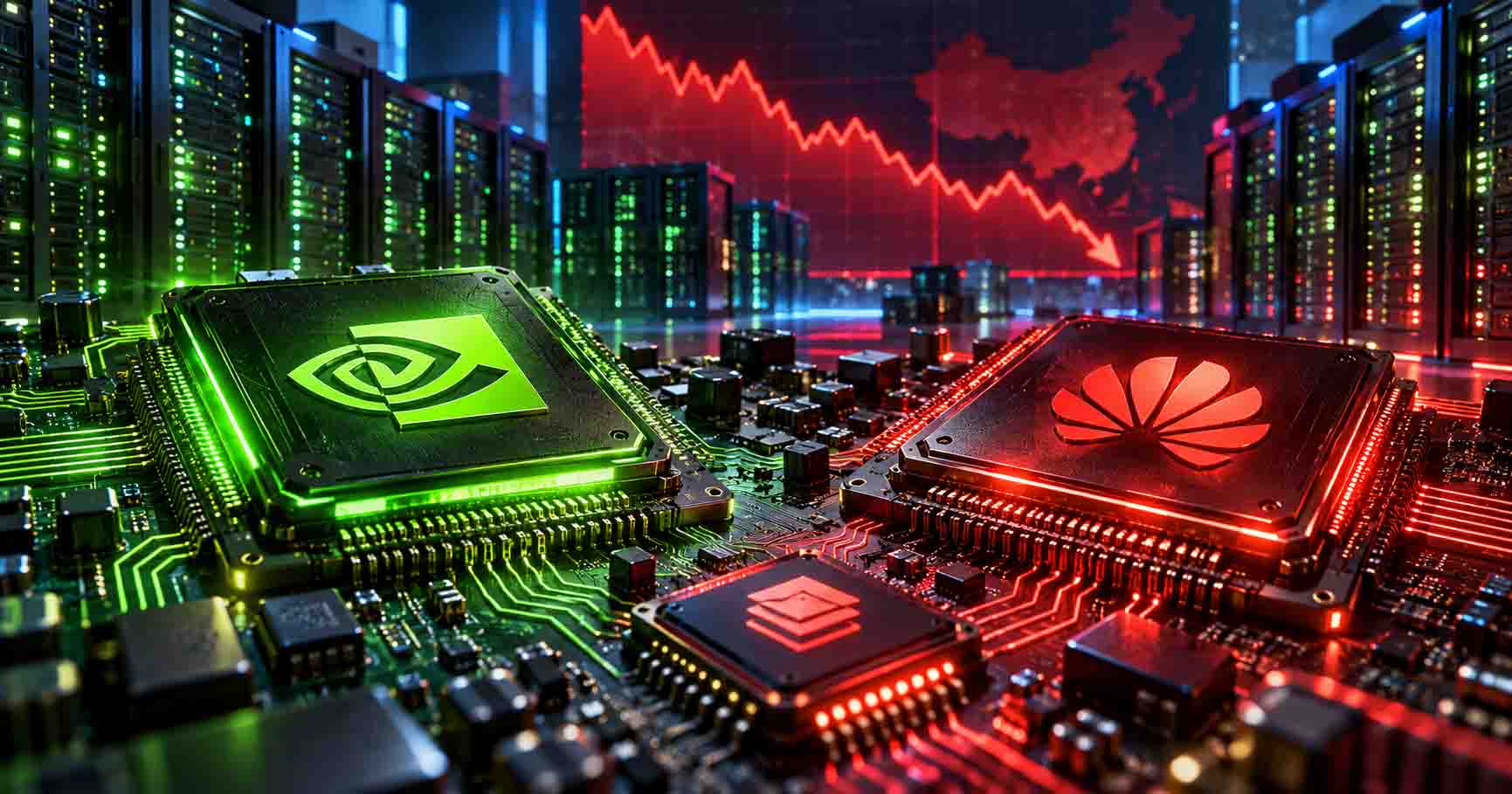
Nvidia in China is facing mounting pressure after new data showed its lead over Huawei shrinking in the country’s AI accelerator market, while a separate Chinese advance in memory technology helped trigger a semiconductor selloff from Seoul to Wall Street.
The developments point to a broader shift than a simple Nvidia-versus-Huawei rivalry. Chinese companies are gaining share in AI accelerators, advancing in memory technology and pushing investors to reconsider who ultimately captures the returns from the enormous global buildout of artificial intelligence infrastructure.
Nvidia in China falls to a 34% share
Nvidia held 34% of China’s data-center AI accelerator market in the first half of 2026, according to IDC data reviewed by Reuters.
The US company shipped about 678,000 AI accelerators between January and June, down 44% from a year earlier.
The decline comes as US export controls restrict access to Nvidia’s most advanced products in China, while Beijing has increasingly promoted domestic alternatives.
Huawei reaches 28% as the gap narrows
Huawei shipped about 572,000 AI accelerators during the same period, up from more than 300,000 a year earlier, giving it 28% of the market.
That leaves just six percentage points between Huawei and Nvidia in the market measured by IDC.
Other Chinese suppliers are also expanding. Alibaba’s T-Head held a 7% share, Cambricon 5%, Baidu’s Kunlunxin 4% and Hygon 3%.
Nine of the 11 Chinese chipmakers tracked by IDC increased shipments from a year earlier.
China is moving beyond traditional GPUs
Total AI accelerator shipments in China reached about 2.008 million units in the first half of the year.
But shipments of graphics processing units, the technology that helped establish Nvidia’s dominance in AI training, dropped 26% to about 991,000 units.
Shipments of other types of AI accelerators surged nearly 80% to 1.016 million units, overtaking GPUs by volume.
Huawei, T-Head, Kunlunxin and Cambricon together accounted for 95% of that non-GPU market, according to IDC.
US export controls reshape the market
Washington has restricted China’s access to Nvidia’s most powerful AI processors on national-security grounds, reducing the range of products the company can officially supply to the world’s second-largest economy.
Beijing has simultaneously promoted domestic processors and tightened oversight of some imports of Nvidia chips that remain eligible for sale.
Nvidia CEO Jensen Huang has repeatedly criticized the US restrictions, arguing they are pushing China’s AI-chip market toward Huawei. He has estimated that market at roughly $50 billion.
CXMT opens a second front in memory chips
The Nvidia-Huawei numbers were not the only source of investor concern.
Reports that Chinese memory manufacturer ChangXin Memory Technologies, or CXMT, had made key progress on a new memory-cell architecture raised fears that Chinese companies are also narrowing the technology gap in another crucial part of the semiconductor industry.
Samsung Electronics and SK Hynix are working on similar innovations aimed at increasing memory density.
That matters because high-performance memory has become a critical component of AI computing and data-center infrastructure.
Samsung and SK Hynix tumble
The concerns quickly spread through Asian markets.
Samsung shares fell more than 7% on Tuesday, while SK Hynix dropped more than 10%.
South Korea’s KOSPI fell more than 6% during the session, extending its losing streak to five days, while Japanese memory-chip producer Kioxia also suffered heavy losses.
The selloff reaches Wall Street
US semiconductor stocks also declined, with the Philadelphia Semiconductor Index falling 1.5% for its fifth consecutive session and reaching its lowest level in about four weeks.
Micron dropped about 4.5%, Seagate 5.9%, Western Digital 5.8% and Sandisk 4.3%.
Nvidia itself slipped about 0.4%, while AMD fell 1.2%, Intel 1.1% and Marvell Technology 2.2%.
The declines follow an extraordinary rally: the US semiconductor index remains more than 70% higher in 2026 despite the recent pullback.
The problem is no longer only China
China’s competitive advance is arriving just as investors become more skeptical about the economics of the AI infrastructure boom.
Financing costs for data centers and related projects have risen as bond yields remain elevated, while investors are demanding clearer evidence that massive capital spending will produce sustainable profits.
BlackRock’s research arm recently cut its view on US equities to neutral, citing potential volatility around the AI buildout.
The International Monetary Fund has also warned that the consequences of a major AI market correction could spread globally through financial markets.
Is the AI boom ending?
The data does not suggest that demand for artificial intelligence is collapsing.
IDC expects total AI accelerator shipments in China to rise 19% in 2026, even as GPU shipments are projected to decline.
What is changing is where that growth goes. A larger share is moving toward Chinese suppliers, specialized accelerators and complete computing systems rather than automatically benefiting traditional GPU leaders.
IDC said competition is increasingly shifting away from the performance of individual chips toward system-level capabilities and the ability to link large numbers of processors together.
The bigger question: who earns the AI profits?
The current selloff does not necessarily mark the end of the AI investment cycle. It may instead signal a new phase in which investors are less willing to reward every company associated with artificial intelligence simply for participating in the boom.
Nvidia retains major global advantages, particularly through its software ecosystem, but China is becoming a different kind of test: US restrictions are helping domestic competitors expand while the Chinese market itself shifts toward alternative accelerator architectures.
For investors, the central question is therefore moving beyond who sells the most chips. With hundreds of billions of dollars being committed to AI infrastructure, the bigger issue is which companies can turn that spending into durable profits.
Sources
- Reuters — Nvidia’s China AI-chip share falls as Huawei closes gap
- Reuters — US chip stocks extend slide as China memory report hits sector
- Reuters — Brutal chip selloff shows AI trade is turning